Kite Foiling Holidays: What Makes a Good Foil Spot, and Where to Find One
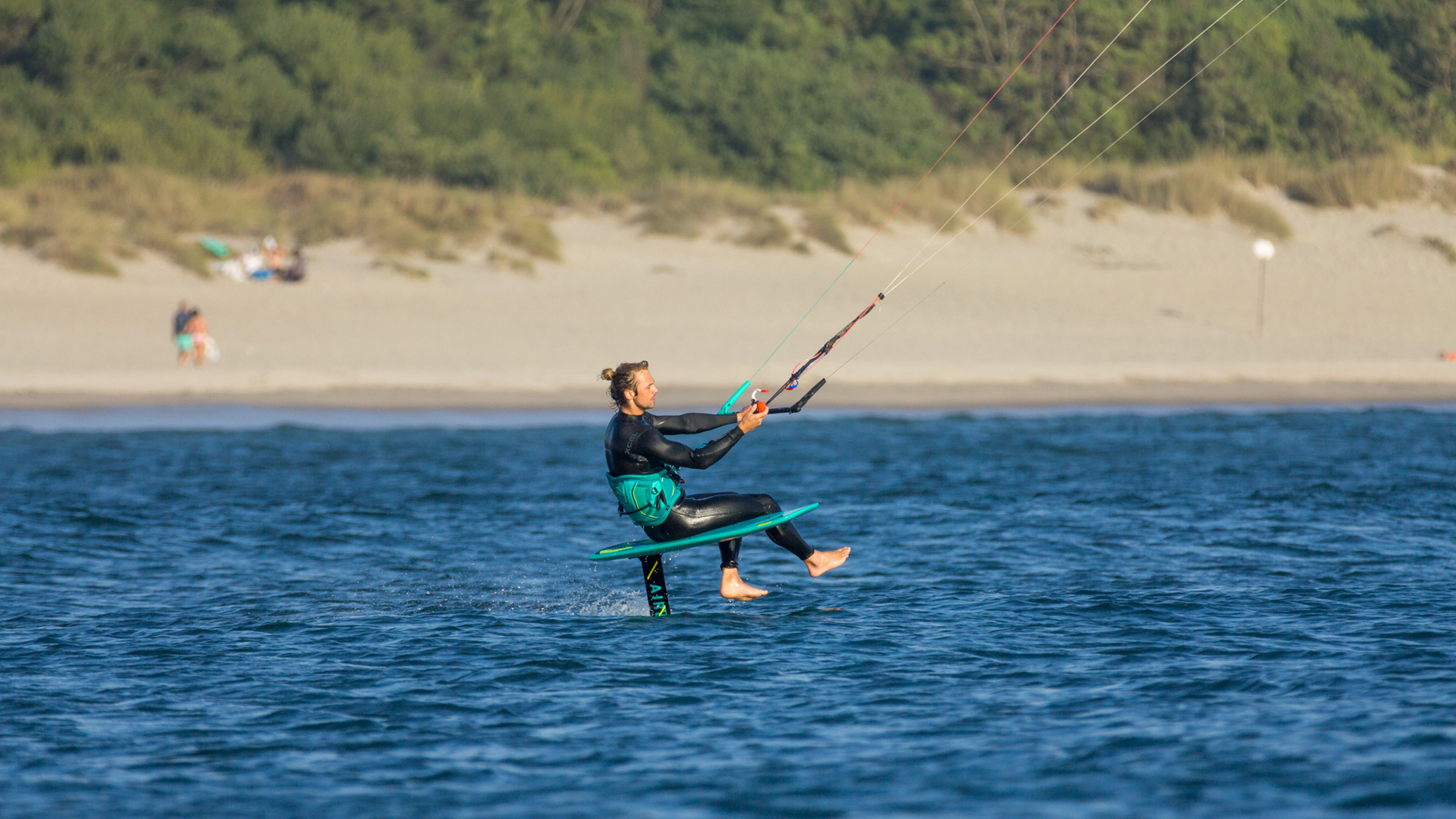
A good kite foiling spot needs three things: light but steady wind, flat water, and enough depth to keep the foil clear of the bottom. Get those and you can ride from around 8–12 knots (well under what a twin-tip needs) which roughly doubles the number of usable days on a week’s holiday.
Why foiling changes the trip, not just the board
The usual argument for a foil is that it is fun. The better argument is arithmetic.
On a normal kite trip, the light days are lost days. You wait, you check the forecast, you go for lunch. On a foil, a lot of those days become sessions — and often the best sessions of the week, because the water is glassy and nobody else is out.
That is why we increasingly book kite foiling holidays for people who have limited annual leave. Same week, roughly twice the water time.
What actually makes a spot good
Depth, which is the counter-intuitive one
Everything you were told about beginner spots gets inverted. A waist-deep lagoon is perfect for learning on a twin-tip and awkward on a foil, because the mast is about a metre long and the bottom is right there. Foiling wants water you cannot stand in, or at least the deeper sections of a lagoon.
Light, steady wind
Thermal winds and trade winds are ideal. A foil spot does not need to be windy — it needs to be consistent. Somewhere that reliably gives 10–14 knots is a better foil destination than somewhere that gives 25 knots half the time and nothing the rest.
Flat water and space
Chop is manageable but flat is better, particularly while you are learning to hold height. Space matters more than on a twin-tip: a foil carries a lot of speed and you cover ground fast.
The spots that have all three
| Where | Why it works | Season |
|---|---|---|
| Langebaan, South Africa | Big, deep, flat lagoon — one of the world’s best foil and wing spots | Nov–Mar |
| Dakhla, Morocco | Steady trade wind, huge lagoon, deeper channels | Year-round |
| Le Morne, Mauritius | Flat lagoon with depth, plus swell outside for foil surfing | Jun–Nov |
| Maldives | Light, clean wind and deep flat water between the atolls | Dec–Apr, Jun–Aug |
| Soma Bay, Egypt | Reliable thermal, deeper water off the lagoon edge | Mar–Nov |
| Lo Stagnone, Sicily | Steady thermal; stick to the deeper channels | Apr–Oct |
Who it isn’t for
If you are not yet riding upwind confidently on a twin-tip, foiling is the wrong next step — get the fundamentals first at a proper beginner spot (learn to kitesurf holidays). And if what you want from a trip is boosting big airs or riding waves, a foil is not the tool; see wave kitesurfing instead.
It is also worth being honest that the learning curve has a sharp edge, literally. A lesson and a helmet for the first few sessions are not optional extras.
Want to try a foil this year?
Several of the centres we work with have demo foils and foil-specific coaching, so you can try before you buy. Tell us your level and when you can travel and we will find you a spot with the right depth, the right wind and someone good to teach you.
Free, with no obligation and no booking fee. We’re a UK tour operator, trading since 2001 —
every resort we sell has been ridden by one of our own team. Mon–Fri, 09:00–18:00 UK ·
5★ on Google from 190+ reviews · ATOL protected (T7314) and Travel Trust Association members.
Frequently asked questions
What makes a spot good for kite foiling?
Light, steady wind and flat water with enough depth to keep the foil clear — roughly waist-deep or more. Foiling rewards places that are too light for twin-tip riding, which is why a good foil spot is often a mediocre freestyle spot and vice versa.
How much wind do you need to foil?
Most riders can foil comfortably from around 8–12 knots, well below the 15 knots plus a twin-tip needs. That is the point: foiling turns marginal days into rideable ones and roughly doubles the usable days at many destinations.
Is kite foiling harder to learn than kitesurfing?
It is a different skill rather than a harder one, but you should be riding upwind confidently on a twin-tip first. Most people take a few sessions to get consistent flight. A lesson is worth it — the crash dynamics are unfamiliar and the foil is sharp.
Can you learn to foil on holiday?
Yes, and it is the sensible way to do it. Several of our destinations have foil-specific tuition and demo kit, so you can try a foil for a session before committing to buying one.
Do you need to bring your own foil?
Not necessarily. Rental and demo foils are available at most of the centres we work with, which also lets you try different setups. If you are travelling with your own, check the airline’s baggage rules — a foil in a board bag can push you over on both weight and length.