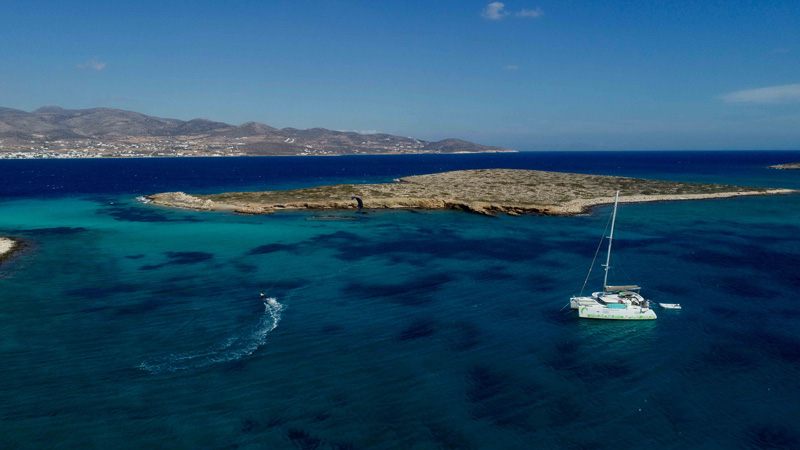
Greek kitesurfing runs on the Meltemi, a northerly that blows through the Aegean from roughly May to October and peaks in July and August. The islands are not interchangeable: Rhodes gives you two seas and the most wind, Kos gives you shallow water and easy logistics, and Limnos gives you a flat bay with almost nobody in it. Which one suits you depends less on the island than on what you are trying to do.
The Meltemi, briefly
The Meltemi is a dry northerly that sets up when high pressure over the Balkans meets low pressure over Turkey. It funnels down the Aegean, accelerates between islands, and can run for three or four days at a stretch before backing off.
It is the reason Greece works as a kite destination at all, and it has two consequences worth knowing before you book. It is strongest in high summer, which is the opposite of most Mediterranean thermals. And it is a synoptic wind rather than a daily sea breeze, so it arrives in cycles — several strong days, then a gap.
Which island
| Island | Main spot | Water | Suits |
|---|---|---|---|
| Rhodes | Prasonisi (south), Ixia/Theologos (north-west) | Flat on one side of the isthmus, waves on the other | Riders who want the strongest wind and the option of both conditions in one day |
| Kos | Marmari and Tigaki, north coast | Shallow, sandy, mostly flat with chop | Improvers, families, and anyone who wants short transfers and plenty to do |
| Limnos | Keros Bay | Wide, shallow, flat | People who want space, quiet and a genuinely uncrowded bay |
Rhodes: two seas, one beach
Prasonisi, at the southern tip of Rhodes, is one of the more remarkable spots in Europe. A sand isthmus joins a rocky islet to the main island, with the Aegean on one side and the Mediterranean on the other. The Meltemi comes across it, which means one side is cross-shore and flat and the other is cross-onshore with swell — and you can change your mind at lunchtime by walking a hundred metres.
It is also the windiest of the three by reputation. In July and August, Prasonisi delivers small-kite days with a consistency that few Mediterranean spots match.
Northern Rhodes is the other half of the island’s offer, and a completely different proposition: closer to Rhodes Town, better for a mixed holiday, and gentler conditions.
Kos: the practical one
Kos is the easiest of the three to organise. The airport is close, the north-coast spots at Marmari and Tigaki are shallow and sandy, and the island has enough going on that a light day is not a problem.
The water is not glassy (there is usually some chop) but it is shallow a long way out, which is exactly what you want if you are still working on transitions or getting somebody else started. This is the island we suggest most often for a couple where one is well past the learning stage and the other is not.
Limnos: the quiet one
Limnos is the one people come back for. Keros Bay is a broad, shallow, flat expanse in the south-east of the island, with a long beach and very little development. On a good Meltemi day there is more usable water than there are riders to use it.
The price of that is remoteness. Limnos takes more effort to reach and offers less to do when the wind stops. That is precisely why it is quiet.
When to go
| Period | Meltemi | Water | Verdict |
|---|---|---|---|
| May – June | Building, less consistent | ~20–23°C | Quieter and cheaper, with real light days. Take a 3/2mm. |
| July – August | Peak. The strongest and most reliable period | ~24–26°C | Book this if wind is the priority. Busiest and hottest. |
| September | Easing but still good | ~24–25°C | The balanced choice. Warm sea, thinner crowds. |
| October – April | Effectively over | ~15–20°C | Not a kiting season. Most centres close. |
What to expect on the water
Most riders are in boardshorts or a shorty from late June onwards, and a 3/2mm in May and early June. Bring a kite quiver that covers both ends — the Meltemi does not do moderate. On a strong cycle you may want a 7m; in the gap between cycles a 12m will earn its keep.
One local habit worth adopting: check the forecast for the whole week rather than the day. Because the Meltemi comes in multi-day systems, it is usually obvious by Monday which days will be the good ones, and worth planning your non-kiting excursions around the gap.
Who this isn’t for
If you want warm, glassy, waist-deep lagoon water and a gentle learning curve, Greece is not the obvious answer. Lo Stagnone in Sicily or Soma Bay will do that better.
And if you can only travel outside the summer, Greece is not open. The Meltemi is a summer phenomenon and the season is short.
But if you can go in July or August, want strong wind, and would like a holiday that is recognisably a Greek island holiday as well as a kiting trip (tavernas, ferries, ruins, swimming off rocks) there is not much in Europe that does the combination better.
Frequently asked questions
When does the Meltemi blow in Greece?
Roughly May to October, peaking in July and August. It is a synoptic northerly rather than a daily sea breeze, so it arrives in cycles of several strong days followed by a lighter gap.
Which Greek island is best for kitesurfing?
Rhodes for the strongest wind and the choice of flat water or waves at Prasonisi, Kos for shallow water and easy logistics, and Limnos for space and quiet at Keros Bay. There is no single best island; they suit different riders.
Is Greece good for learning to kitesurf?
Kos is the most forgiving of the three, with shallow sandy water a long way out. Greece in general is less ideal for absolute beginners than a standing-depth lagoon, because the Meltemi can be strong when it is on.
Do you need a wetsuit for kitesurfing in Greece?
A 3/2mm in May and early June, and boardshorts or a shorty from late June through September. The Aegean warms up to around 24 to 26 degrees in peak summer.
What size kites should I bring to Greece?
Bring both ends of your quiver. The Meltemi does not do moderate, so a 7m earns its keep on a strong cycle and a 12m is what you will ride in the gaps between systems.
Which Greek island fits your week?
Tell us your level and the weeks you can travel. We will match you to the island and the spot rather than selling you the one with the most availability.
Free, with no obligation and no booking fee. We’re a UK tour operator, trading since 2001 —
every resort we sell has been ridden by one of our own team. Mon–Fri, 09:00–18:00 UK ·
5★ on Google from 190+ reviews · ATOL protected (T7314) and Travel Trust Association members.