Sardinia’s kitesurfing centres on Porto Pollo, a bay on the island’s northern tip where the Mistral funnels through the Strait of Bonifacio. The season runs May to September, the western bay is shallow and flat enough to learn in, and the wind arrives in two quite different flavours depending on the week you book. Olbia airport is about 40 minutes away.
Why the wind is so good here
Look at a map of the Strait of Bonifacio, the narrow channel between Sardinia and Corsica, and the reason becomes obvious. Air moving south-east across the Mediterranean gets squeezed through a gap a few miles wide with high ground on both sides. It accelerates. Porto Pollo sits directly in the outflow.
That is why northern Sardinia punches above its weight as a European kite destination. It is not a trade-wind belt, so it will never match Cape Verde for pure consistency. But when the Mistral is running, this is one of the windiest bays in the Mediterranean.
The two winds, and why it matters which one you get
Almost everything about your week depends on which wind is blowing.
| Wind | Direction | Typical strength | What it’s like |
|---|---|---|---|
| Mistral | North-west | 20–30 knots, sometimes more | The famous one. Arrives as a weather system, can run for days, and turns the bay into a small-kite playground. Gusty at the edges, cleaner out in the middle. |
| Ponente / thermal | West to south-west | 12–20 knots | The summer sea breeze, building through the afternoon. Softer, steadier, and much friendlier if you are still working on your upwind. |
A week with a Mistral cycle in it is the best kiting of the European summer. A week of pure thermals is a pleasant, gentler holiday where you will be on a bigger kite and riding from lunchtime onwards. Neither is a bad week. But if you have travelled specifically to ride overpowered, the difference matters, and it is worth knowing that nobody can promise you which one you will get.
Where you actually ride
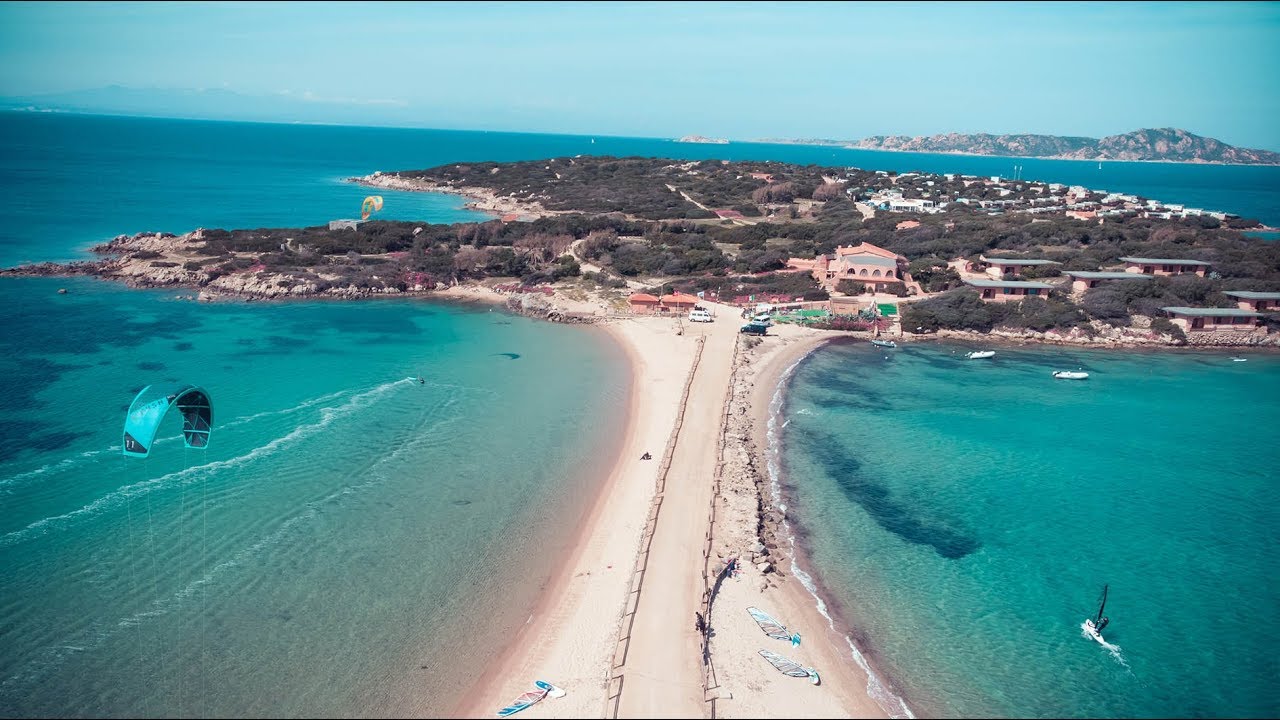
The bay is split by a sandy isthmus running out to Isola dei Gabbiani, the headland at the end. That geography gives you two completely different beaches within a few minutes’ walk.
The western side is the shallow one. Waist-deep across a large area, sandy bottom, and the wind comes in side-onshore. This is where the schools work and where most people spend their first few days. It is also where you go when the Mistral is honking and you would rather not be dealing with chop as well.
The eastern side is deeper and gets a bit more texture on the water. More space, fewer people, and better if you want to ride fast and jump.
Being able to swap sides based on the day is useful, and it is the thing riders who have only kited one-spot destinations tend to underrate.
When to go
| Period | Wind | Water | Verdict |
|---|---|---|---|
| May – June | Good Mistral frequency, thermals building | ~19–22°C | Our pick. Strong wind statistics, and the island is not yet full. |
| July – August | Reliable thermals, less frequent Mistral | ~24–26°C | Warmest water and busiest beaches. Good for families, less good for wind chasers. |
| September | Mistral returns | ~23–25°C | The quiet favourite. Warm sea, emptier bay, proper wind systems. |
| October – April | Windy but cold and unreliable | ~14–18°C | Not a holiday season. Centres are closed. |
What to bring
The Mediterranean in high summer is warm but this is not the tropics. Most riders are in a shorty in July and August and a 3/2mm full suit in May, June and September. A wider kite quiver earns its keep here more than at a trade-wind destination — if you own a 7m and a 12m you will use both, sometimes in the same week.
Who this isn’t for
If you need to ride every single day of your week, Sardinia is the wrong choice and we would rather say so now. A Mediterranean destination has light days. Dakhla and Sal are the destinations to look at if statistical certainty is what you are buying.
It is also not the flattest water in Europe. If you are learning, or you want mirror-flat lagoon conditions for freestyle, Lo Stagnone in Sicily is the better Italian answer — a lagoon you can stand up in almost anywhere.
What Sardinia gives you that neither of those does is a proper holiday around the kiting: granite coastline, the Costa Smeralda a short drive away, La Maddalena archipelago off the beach, and food worth planning your evenings around. For a couple where one person kites and the other does not, that balance is hard to beat.
Getting there
Olbia (OLB) is the airport, roughly 40 minutes by road to Porto Pollo, with direct summer flights from several UK airports. Alghero and Cagliari also serve the island but are a long drive from the north coast. See the full Italy collection for how the Sardinian and Sicilian options compare.
Frequently asked questions
When is the best time to kitesurf in Sardinia?
May, June and September are the strongest all-round months: good Mistral frequency, warm enough water and far fewer people than July and August. High summer has the warmest sea and the most reliable thermal breeze, but the powerful Mistral systems are less frequent.
Is Porto Pollo good for beginners?
Yes, on the western side of the bay. It is shallow, sandy and waist-deep across a large area, with side-onshore wind, and the schools are based there. On a strong Mistral day it becomes an advanced spot, so it depends as much on the week as the beach.
Do you need a wetsuit in Sardinia?
Most riders wear a shorty in July and August and a 3/2mm full suit in May, June and September. The Mediterranean is warm but a windy Mistral afternoon is cooler than the air temperature suggests.
What is the difference between the Mistral and the thermal wind?
The Mistral is a north-westerly weather system that funnels through the Strait of Bonifacio at 20 to 30 knots or more and can run for several days. The thermal is a lighter west or south-west sea breeze of 12 to 20 knots that builds through the afternoon. Both are rideable; they need very different kites.
Which airport do you fly into for Porto Pollo?
Olbia (OLB), roughly 40 minutes by road, with direct summer flights from several UK airports. Alghero and Cagliari also serve Sardinia but both involve a long drive to the north coast.
Thinking about Sardinia?
Tell us the weeks you can travel and we will tell you honestly what the wind statistics look like, which side of the bay suits your level, and whether Sardinia or Sicily is the better fit.
Free, with no obligation and no booking fee. We’re a UK tour operator, trading since 2001 —
every resort we sell has been ridden by one of our own team. Mon–Fri, 09:00–18:00 UK ·
5★ on Google from 190+ reviews · ATOL protected (T7314) and Travel Trust Association members.
Porto Pollo is number eight in our guide to the best kitesurfing holidays, mainly because it is the shortest flight on the list.