The Caribbean kite season runs on the trade winds from roughly December to July, with the strongest and most reliable months from January to April. Outside that window the wind drops and the hurricane season starts. Which island you pick should follow the conditions you want: Union Island for flat lagoon water, Aruba for raw wind strength, Barbados and St Lucia for a mix of chop and swell.
The season, first
Almost every mistake we see people make about Caribbean kiting is a timing mistake. The trades are a winter and spring phenomenon here.
| Period | Wind | Verdict |
|---|---|---|
| December – February | The “Christmas winds” — strong and consistent | Peak season. Book well ahead; this is also the busiest tourist window. |
| March – April | Still excellent, slightly warmer | Our pick. Reliable wind and the crowds are thinning. |
| May – July | Easing but still rideable, especially in the south | Good value. Aruba holds on longest. |
| August – November | Light, humid, hurricane season | Not a kiting season. Avoid. |
Which island
Union Island — the flat one
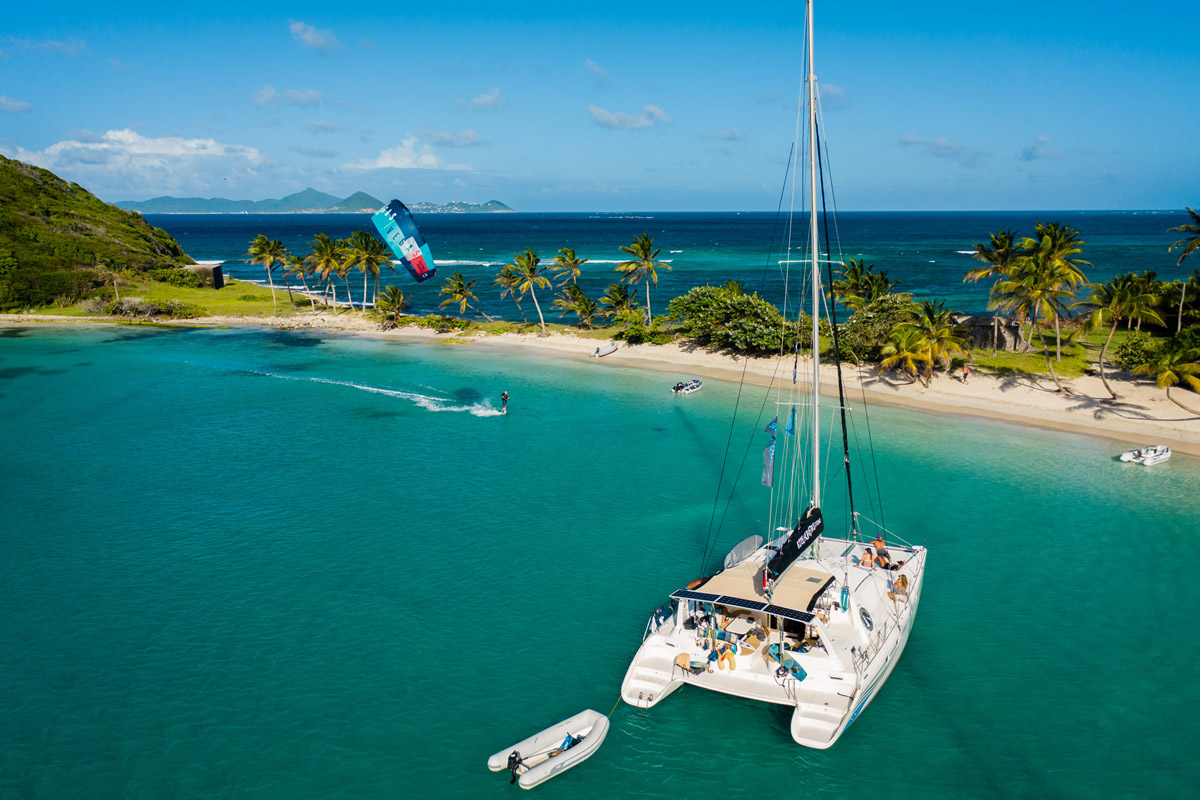
Union Island in the Grenadines is the one to pick if flat water is the priority. The lagoon behind Frigate Island is shallow, protected by reef, and sits directly in the trade wind. It is the closest thing the Caribbean has to a Dakhla-style lagoon, at a fraction of the crowd.
The island itself is tiny and low-key — Clifton is a small harbour town, and the Tobago Cays are a short boat ride away and worth the day. This is the trip for someone who wants flat water, sailing-boat scenery and no resort machinery.
Aruba — the windy one
Aruba sits outside the main hurricane belt and catches the trades harder than most of the region. It is the closest thing to a wind guarantee in the Caribbean, and its season stretches further into the summer than anywhere else here.
Fisherman’s Huts on the north-west coast is the everyday spot: shallow, sandy, side-onshore, and busy. Boca Grandi on the wild east coast is the wave option and is strictly for experienced riders — rocky, powerful and unforgiving.
Aruba also has the most developed tourism of the four, which cuts both ways depending on what you want your evenings to look like.
Barbados — the one with swell
Silver Sands on the south coast is a proper Caribbean kite institution: strong trades, chop and swell rather than flat water, and a long-established scene. Barbados suits a confident rider who wants to jump and ride waves, and it has more going on off the water than most of the islands here.
It is not the place to learn. The water is textured and the shorebreak has bite.
St Lucia — the balanced one
Anse de Sables at Vieux Fort, on the southern tip, gets the trades funnelled between St Lucia and St Vincent. The bay is broad and sandy, the water is flat close in and choppier further out, and it works for a wide range of abilities. St Lucia also gives you the most dramatic island of the four to look at, which matters more than it should.
Choosing between them
| If you want… | Go to |
|---|---|
| Flat, shallow, uncrowded water | Union Island |
| The strongest, most reliable wind | Aruba |
| Swell, jumping and an established scene | Barbados |
| A mix, plus a spectacular island | St Lucia |
| A first-ever kite lesson | Union Island or St Lucia |
What to expect on the water
Water temperatures sit around 26–28°C across the region all season, so this is boardshorts and rash-vest kiting. The trades are usually side to side-onshore at the main spots, which is the safe direction.
Kit-wise, most riders find a 9m and a 12m covers the season, with a 7m worth having for a strong January week in Aruba or Barbados.
Who this isn’t for
Anyone whose only free window is July to November. The Caribbean does not work then, and we would rather point you at Greece, Sardinia or Portugal for those months than sell you a still week in the sun.
It is also not the cheapest kiting per windy day. Flights are long and Caribbean accommodation is not budget. If pure wind hours per pound is the metric, Egypt and Cape Verde will beat it comfortably.
What the Caribbean gives you instead is warm water, reliable winter wind, and islands that are a pleasure to be on whether or not it is blowing. For a January escape with a partner who has no intention of getting on a kite, it is very hard to argue with.
Frequently asked questions
When is the Caribbean kitesurfing season?
Roughly December to July, with January to April the strongest and most reliable. The Christmas winds arrive in December and the trades ease through early summer. August to November is hurricane season with light wind and is not a kiting season.
Which Caribbean island is best for kitesurfing?
Union Island for flat lagoon water, Aruba for the strongest and longest wind season, Barbados for swell and jumping, and St Lucia for a balance of conditions on a scenic island.
Is the Caribbean good for learning to kitesurf?
Union Island and St Lucia are the better choices, with sheltered, shallow water and established schools. Barbados and Aruba’s east coast are too powerful for a first week.
Do you need a wetsuit in the Caribbean?
No. Water temperatures sit around 26 to 28 degrees across the region all season, so boardshorts and a rash vest for sun protection are enough.
What kites should I bring to the Caribbean?
A 9m and a 12m covers most of the season. A 7m is worth packing for a strong January or February week in Aruba or Barbados.
A Caribbean kite trip, planned around the wind
The season is narrower than most people expect. Tell us when you can travel and we will tell you which islands are working then, and which ones are not.
Free, with no obligation and no booking fee. We’re a UK tour operator, trading since 2001 —
every resort we sell has been ridden by one of our own team. Mon–Fri, 09:00–18:00 UK ·
5★ on Google from 190+ reviews · ATOL protected (T7314) and Travel Trust Association members.